All-Terrain Prosthetic Ankle-Foot

Design Project • CAD • FEA • Prototyping

Project Overview

Designed and validated a fully mechanical, dual-axis ankle-foot prosthesis to improve stability and adaptability during walking on uneven terrain. The system provides natural ankle motion without electronics, prioritizing reliability, manufacturability, and cost-effectiveness.

The design focuses on passive mechanical compliance to accommodate real-world terrain variations while maintaining structural integrity under repeated physiological loading. All components were developed with rapid prototyping and scalability in mind.
Engineering Objectives

  • Enable controlled dorsiflexion and plantarflexion during gait
  • Accommodate inversion and eversion caused by uneven terrain
  • Ensure structural safety under cyclic body-weight loading
  • Design for ease of manufacturing and assembly
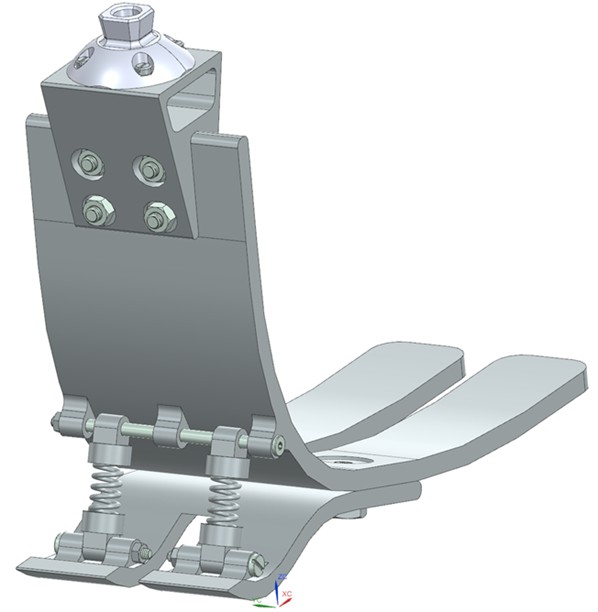
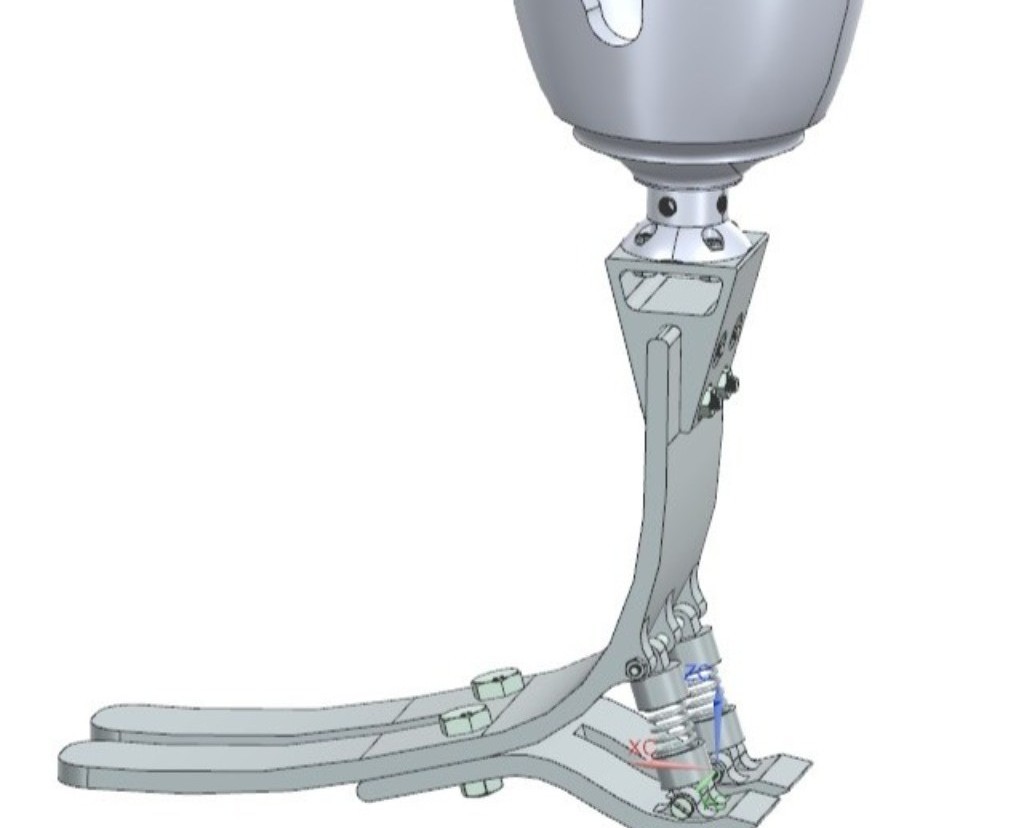
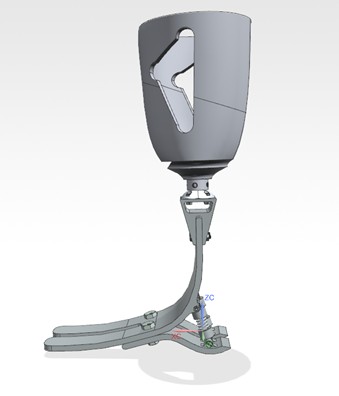
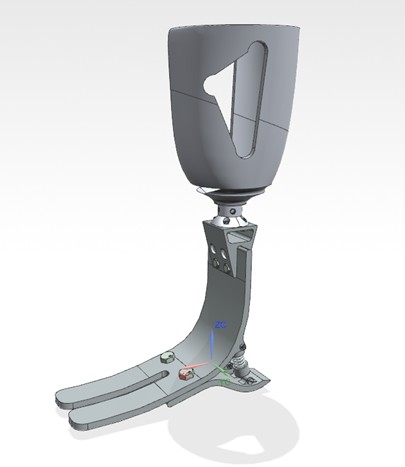
CAD Assembly
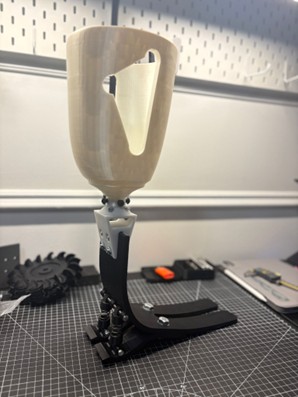
Mechanical Detail

My Technical Contributions

  • Developed parametric CAD models and full mechanical assemblies
  • Defined load paths, joint interfaces, and component constraints
  • Selected materials based on strength, stiffness, and manufacturability
  • Prepared engineering documentation and design rationale

Key Design Decisions

  • Dual-degree-of-freedom architecture for realistic ankle motion
  • Spring-based restoring mechanisms to maintain neutral alignment
  • Modular design enabling rapid iteration and testing

Engineering Analysis & Validation

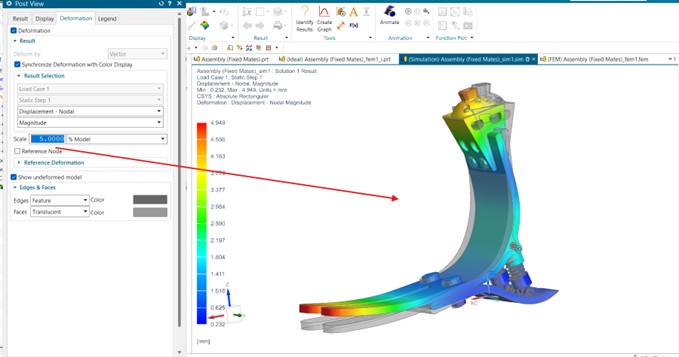
Finite Element Analysis (FEA) was conducted to assess the structural performance of critical load-bearing components under representative walking loads.
Analysis Setup

  • Applied vertical and angled loads simulating stance-phase loading
  • Boundary conditions defined at pylon and ground-contact interfaces
  • Material models for PETG and rigid photopolymer resin

Results

  • Peak stresses remained below material yield limits
  • Deflections stayed within acceptable ranges for gait stability
  • Identified stress concentrations for future geometric refinement
FEA Results
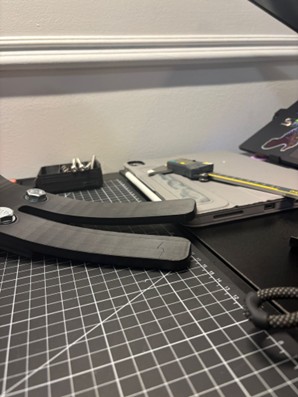
Testing

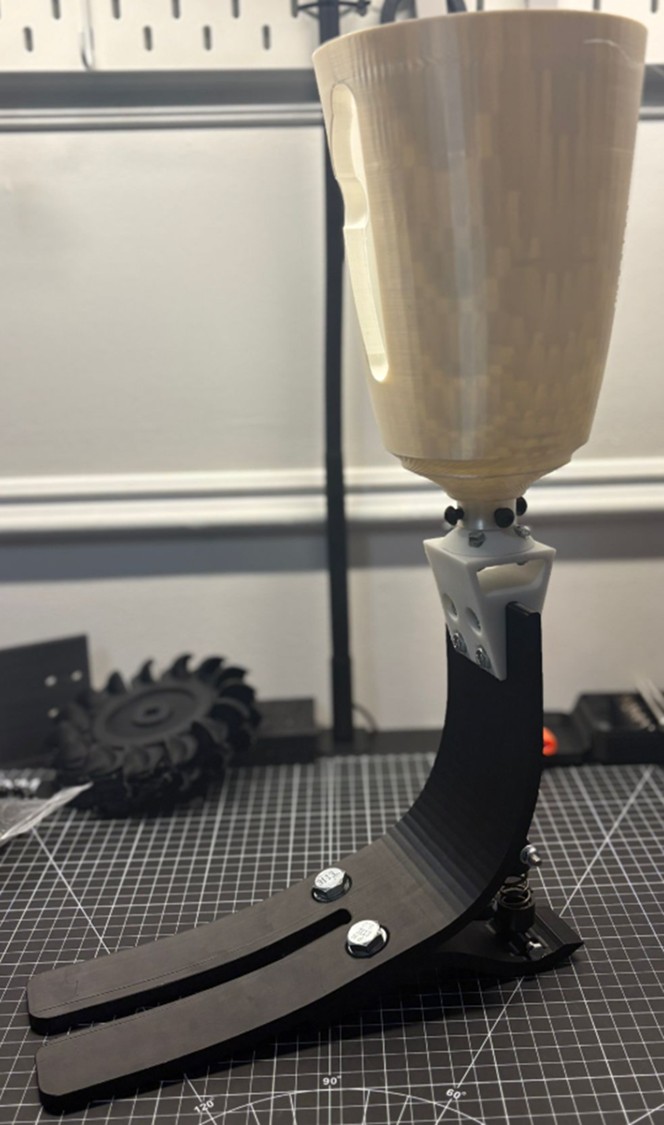
Manufacturing & Testing

Manufacturing Methods

  • FDM 3D printing (PETG) for structural foot components
  • SLA resin printing for precision ankle housing features
  • PLA components for non-load-bearing elements
  • Standard fasteners and mechanical springs

Prototype Evaluation

  • Manual load testing to assess articulation and compliance
  • Observed inversion and eversion response on uneven surfaces
  • Compared physical behavior against analytical expectations

Outcomes

  • Validated stable dual-axis motion without electronic control
  • Confirmed structural robustness under realistic loading
  • Established groundwork for future fatigue and gait-cycle testing

Prototype Demonstration